Cycle-to-work schemes show success, but e-bikes complicate the corporate commute. While office facilities are struggling to adapt, a new B2B infrastructure market is starting to emerge.
Cycle-to-work schemes, where employers help employees buy or loan bikes, can boost commuters’ wellbeing and cut their travel fuel costs. Google’s bike-to-work programme that began in 2015 offered incentives to buy or borrow bikes. Many other companies have followed suit, and it is not uncommon to hear of all kinds of cycle-to-work schemes.
A study published in Frontiers in Future Transportation evaluated Google’s programme to find that bike lending and buying incentives can be very influential for boosting the number of bike commutes in a company.
But in 2026, has the rise of e-bikes changed the tone for companies’ support to cycle-to-work?
Cycle-to-work schemes at Google and beyond
In 2015, Google started a new bike-to-work programme to encourage bike commuting to their two main corporate campuses in California, where they lent conventional and electric assisted bikes to employees for free, and incentivized bike purchases.
Google’s programme was an ideal case study for a team of U.S. researchers to investigate the effectiveness of a large employer-sponsored bike and e-bike lending programme. The team synthesised and modelled anonymised survey and trip data collected from the initiative. Bivariate and multivariable analysis methods showed bike commute increases of approximately 1.7–2.3 days per week. This is roughly a tripled uptake of bike commute rates for employees.
This resulted in around 15 miles of reduced single occupancy vehicle (SOV) driving per week for an average participant, showing how influential the program can be for behavioural change. The shift was not temporary, as after the trial ended, the numbers of bicycle commutes decreased slightly but were still greater than before the experiment started.
This was among the first large-scale employer-based evaluations of a bike and e-bike lending programme in North America. It is but one of example that commuting behavioural change is possible when the right company incentives are in place.
2026 corporate commute challenges with the rise of e-bikes
With the safety concerns of non-compliant lithium ion batteries in e-bikes, it is a different story in the wider corporate landscape.
The goal is smart charging for multiple e-bikes at an office site, without exceeding a property’s power supply, as opposed to rapid-charging like for a Tesla. Trying to supercharge for e-bikes could cause immense heat for small lithium-ion packs!
In some jurisdictions, particularly in parts of the UK and certain US cities, fire authorities have introduced tighter guidance or enforcement around lithium-ion battery storage and charging. This means that office blocks who cannot provide cycling and charging facilities with the required fire-safe e-bike infrastructure might be at a competitive disadvantage in tight office rental markets, especially as tenants increasingly track Scope 3 commuting emissions.
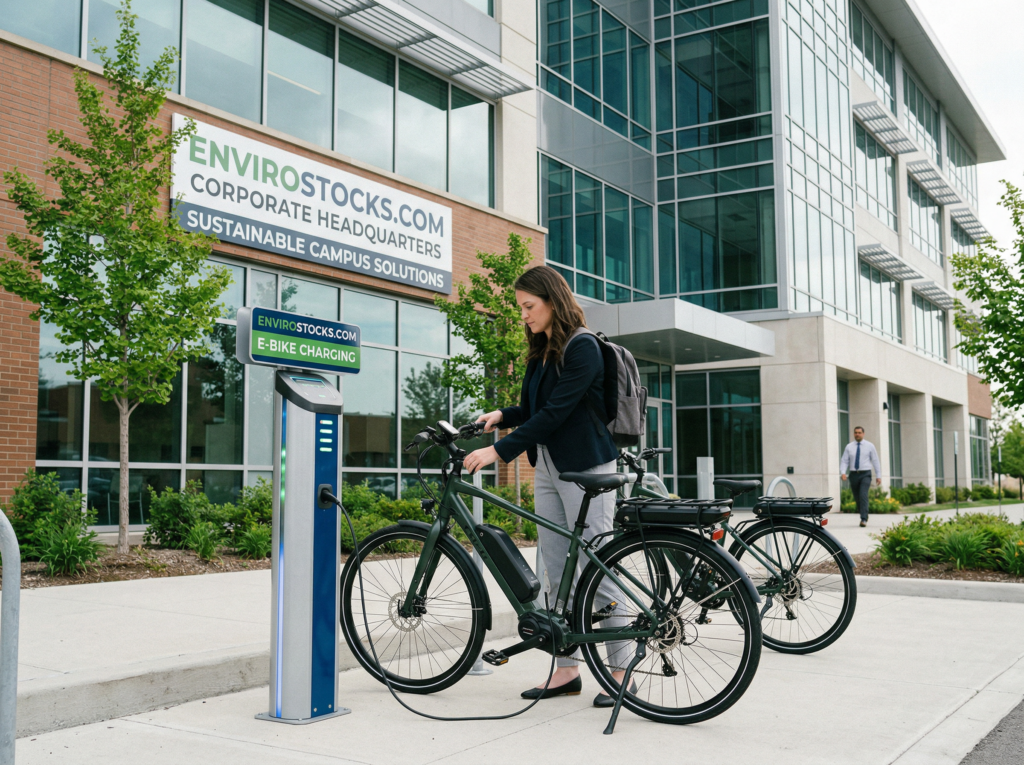
Why e-bike charging facilities matter to employees and companies
Having e-bike charging facilities matters for employee satisfaction within a company, some might not even accept a job without bike storage on hand, particularly in busy locations like central London.
However, e-bike charging could cause some complications. Some employees have reported policies at companies where they are not allowed to charge an e-bike due to fire safety concerns. It may be the insurance complications. But are these safety concerns over-hyped?
From an engineer’s perspective, it may be that the bad press around e-bikes going up in flames come from DIY e-bikes built at home using kits purchased online – which are not strictly regulated. But it is too tricky for a company to work out which ones are DIY and which ones aren’t. Therefore, some may just choose a blanket rule.
Some sources suggest that leaving an e-bike charging unattended is not advised according to the manual even of reputable manufacturers.
So for the two-wheeled work commuter, is the classic bicycle here to stay? It would seem so, as companies continue to be unsure what to do with the risk concerns around e-bikes.
Specialist manufacturers shift to the fire-rated smart charging segment
Companies adapting to offer fire-rated, smart-charging lockers in cities like London, may be positioned to benefit from growing demand for compliant charging solutions, which corporate office buildings cannot accommodate by themselves.
Some of these companies have fire-proof measures in place to bypass the blanket bans.
Falco UK: They produce the FalcoCharge-Vault, an explosion-resistant locker tested to withstand internal lithium fire temperatures of up to 1200°, plus e-bike charging racks.
metroSTOR: They manufacture the BIKE-E” lockers, featuring factory-fitted internal fireboard lining designed to contain thermal runaway without breaching commercial building insurance limits.
These are different to pay-to-use bike storage locker spaces for the public, as found in London. They serve commercial offices directly, particularly those seeking to improve compliance, insurance compatibility, and tenant appeal in a competitive market.
This article is for informational purposes only and does not constitute investment advice. Envirostocks.com will not be liable for any investment decisions made by our readers.
References and links
Fitch-Polse, D.T., Gao, Z., Noble, L. and Mac, T., 2022. Effectiveness of Free Bikes and E-Bikes for Commute Mode Shift: The Case of Google’s Lending Program. Frontiers in Future Transportation, 3, p.886760. Available at: https://doi.org/10.3389/ffutr.2022.886760



Be First to Comment