Our analyst investigated whether consumers can potentially save money by switching to an electric car. So what’s the answer? Yes and no. Here’s why.
Let’s go a drive in a Nissan Leaf. 1 kilowatt of energy equates to 3.5 miles. But how much does that cost on the quick commute or longer journeys?
On the road you will find electric car chargers all around, but the costs involved vary greatly. We show you just how much and answer why.
Not all electric cars or chargers are made equal
Some are named rapid chargers, while others are so-called quick chargers (but really are just regular chargers). The difference is clear when the vehicle is actually hooked up.
A rapid charger could cost you 70-90p per kWh. That is 10 times more than a charging at home with a smart tariff for 7-9 per kWh.
But here’s the caveat. A rapid charger can be a life saver if you’re short of time and need a quick charge on a long drive. A Nissan Leaf can be 80% charged in 30 minutes. Just enough time for a cuppa, without overstaying your welcome.
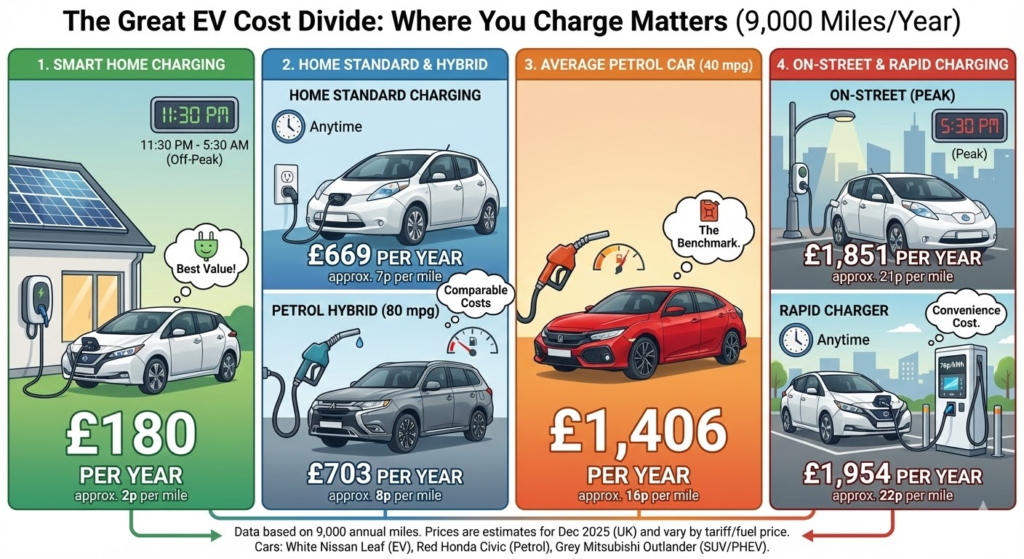
But if you make a habit of it, it will drain your wallet faster than petrol fuel. So does that make the switch to electric vehicles worth it?
Yes. Here is why.
There are economical habits that will lead to cost savings if you choose electric over a traditional combustion engine. The gold advantage would be to have smart charging set up at home. If you can install an electric charger for your vehicle, it will cost you around 9p per kWh.
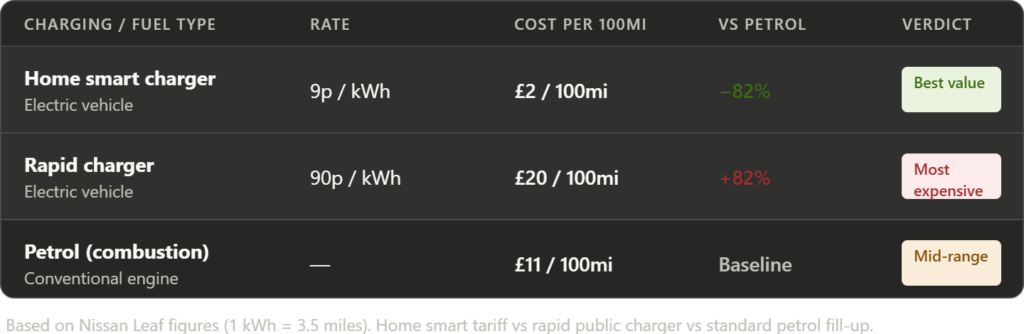
That’s 5 times less than filling up at the gas station with a conventional engine. The table figures below show the extent of the contrast below. The table shows that standard petrol car fuel cost is about £11/100mi while an electric car is £2/100mi at 9p/kWh electricity and £20/100mi at 90p/kWh electricity.)
If you don’t have the option of installing an electric charger at home, using regular (or quick) charging will be much more economical than a fast charge.
Most stops offer both options. But can come with some headaches, which we will explain.
First it is important to get an idea of the speed of charge these options give.
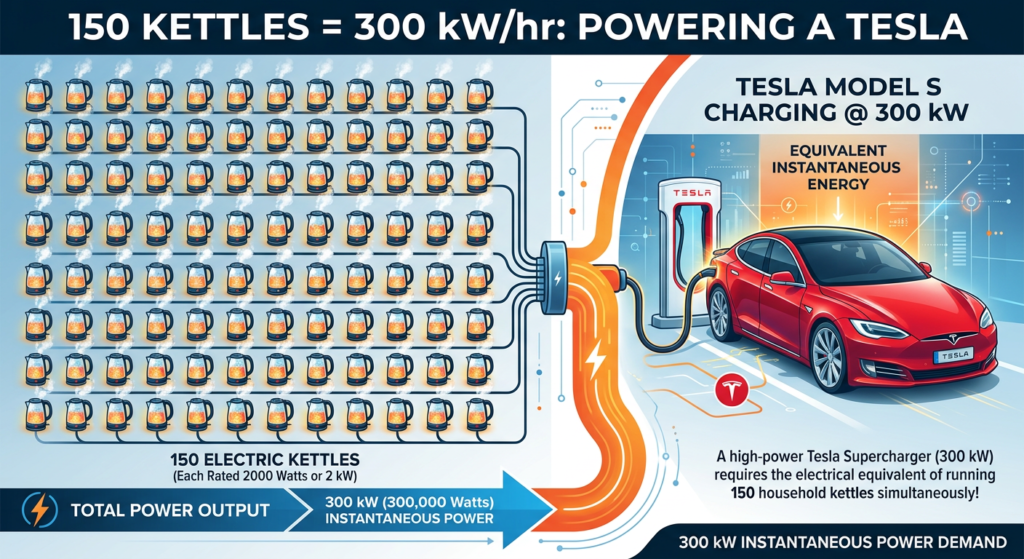
A regular charge offers about 7 Kw/hr and a rapid charge gives 50 kW/hr on average for a Nissan Leaf (up to 300 kW/hr for a Tesla – that’s switching on 150 kettles at once! That’s a lot of tea to drink). Some may only have what some call a ‘granny charger’ at 2 Kw/hr (but these are thankfully less common).
The issue with e-car charge points: Musical chairs
Rapid charger can face technical issues. If you always use rapid chargers the battery of the electric car can degrade quicker than using slower chargers.
Registering for a new app is often required, which adds time before anything gets charged.
Motorway pit stops can be busy, you might have to wait for someone to leave. If it isn’t a rapid charger, that will be later than sooner!
Companies rectifying the apps issue at e-car charge points
Octopus Electroverse offer cards that are compatible with different networks, meaning you can skip the need to download a different app at different charge points.
To streamline your plan, try the Zapp map, which shows you where the rapid and quick chargers are located for your particular vehicle.
Bear in mind, that there are different types of chargers with different vehicle compatibilities…
Types of e-car chargers and capabilities
In its usual exclusive style, Tesla has its own unique charge-point. But for other models, it can be a bit of a minefield, but here’s a rough guide:
Quick chargers are all DC (Direct Current) types (a normal household plug would be an alternating current). But they have different charger types (visibly different by their sockets).
Most of the time you don’t have to worry about the different types, because 92% of EVs use the CCS (Combined Charging System) type. CCS1 was in North America and CCS2 is in Europe. So many charge points have these options.
Stopped by the new Mercedes Benz chargers now that they are live.
— Nichole (@KilowattGirl73) March 20, 2026
I was pleasantly surprised to see they are only charging .40 kWh. The Tesla Supercharger is .37 kWh down the road. pic.twitter.com/cWieH3gpmZ
There are other types that are less common, like the Nissan Leaf which uses a Japanese type called CHAdeMO.
While DC is used for rapid charging. It is AC used for home charging. Home chargers typically have a type called Type 2 (Mennekes). If you buy a home charger, it will almost always be a Type 2 (but don’t confuse it with CCS2 – the rapid charger!)
This begs the question of what electric vehicles offer the most cost savings once we are actually plugged in. How does Tesla compare to Nissan Leaf? The short answer is that it depends on the Tesla model. For deep detailed insights, click here for early access to an upcoming report on this.
Envirostock’s insight: Is it worth getting an electric car economically?
Is it worth investing in electric vehicle companies like Tesla or chargepoint companies like Podpoint? Only you can decide, but see our related article on why the Podpoint share price has plummeted, despite initial optimism in the market. Perhaps overcoming some of the challenges mentioned in this article could support the popularisation of these technologies. For now, something might just be holding people back from taking the drive from fossil fuels to electricity, whether it’s time efficiency, lack of familiarity or chargepoint uncertainty.
Thanks for reading Envirostocks, where you can be the first to know, how green stocks may grow.
Statements:
The visual information design throughout this report was supported by guidance from B2Binfographics.com
EnviroStocks has no commercial relationship with Octopus Electroverse or any other companies mentioned throughout this report.

Be First to Comment